
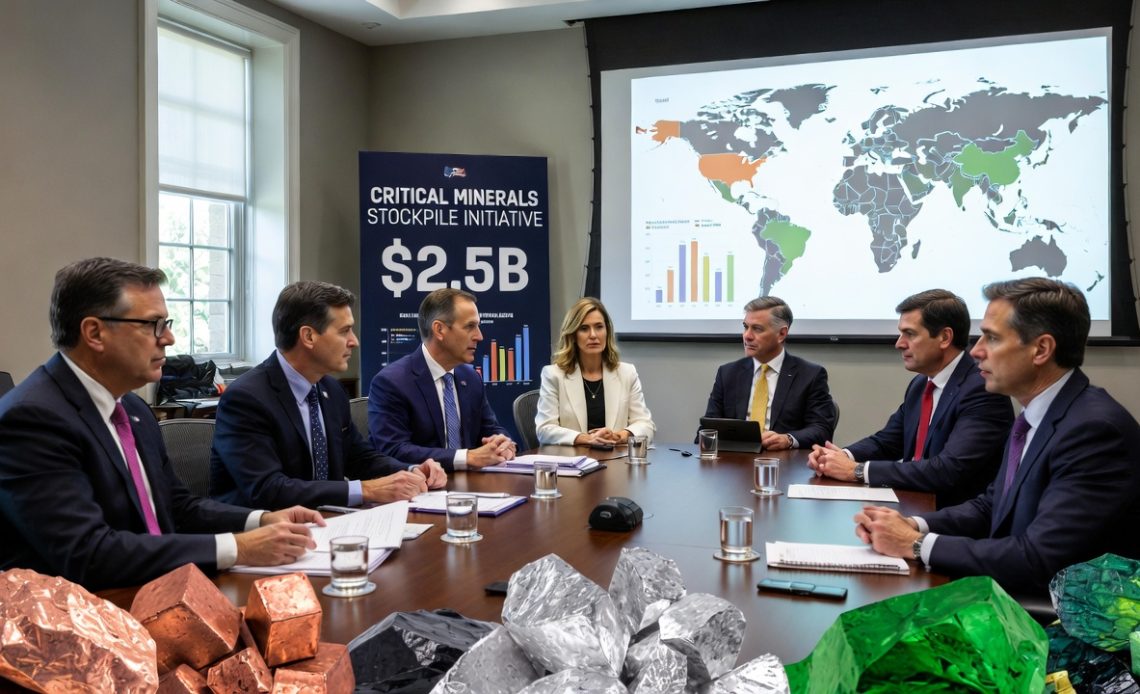
A bipartisan group of US lawmakers moved to stabilise critical mineral markets on Thursday, introducing a bill that would establish a $2.5 billion national stockpile aimed at boosting domestic mining and refining.
Washington’s new bill is the latest measure intended to counteract what its policymakers see as China’s price manipulation of critical minerals like lithium, nickel, and rare earths, according to a Reuters report.
This manipulation has hampered American mining companies for years and affects the supply of materials essential for products ranging from electric vehicles to advanced weaponry.
Countering China’s influence on critical minerals
China’s influence over critical mineral prices and supply volumes is seen as a deliberate strategy, or “weaponization,” in the global competition for these resources, according to the 68-page bill.
This escalating Chinese competition has had tangible effects, such as the glut of lithium produced by China, which prompted North Carolina-based Albemarle to suspend its US expansion plans in 2024.
Furthermore, the US government has responded to this challenge; for instance, the Pentagon became the largest shareholder in Nevada-based rare earths company MP Materials in July.
Proposed legislation intends to shield the US from foreign threats.
In November, China denied claims of manipulating the critical minerals market, stating its dedication to “upholding the security and stability of global production and supply chains.”
For the measure to become law, it requires passage by both the House of Representatives and the Senate, followed by President Donald Trump’s signature.
The strategic resilience reserve: structure and mandate
The new bill proposes the establishment of a Strategic Resilience Reserve, governed by a seven-person board modelled after the Federal Reserve’s structure, according to the Reuters report.
This board, with members nominated by the president and confirmed by the Senate, would be responsible for overseeing the fund and procuring minerals deemed critical by US agencies for national stockpiles in warehouses across the country.
A crucial aspect of the board’s mandate is the requirement for technical expertise to guarantee the proper storage of these minerals; for instance, certain lithium derivatives can release hydrogen if they come into contact with water.
While the bill prioritises the acquisition of recycled materials, minerals extracted from mines are also eligible.
Furthermore, allied nations may participate in the reserve by contributing a minimum of $100 million.
Profits generated from the sale of minerals—either for private-industry or defence applications—would be continuously reinvested.
This reinvestment cycle is designed to acquire additional minerals, ensuring the perpetual maintenance and activity of the stockpile.
Broader implications and international response
Senator Jeanne Shaheen, a New Hampshire Democrat and the ranking member of the Senate Foreign Relations Committee, stated that targeted investments and stockpiling of key inputs would be a cost-effective strategy to significantly boost the US economy and protect the nation from foreign threats.
The legislation was co-sponsored in the Senate by Indiana Republican Senator Todd Young.
The corresponding measure in the House was introduced by Representative Rob Wittman, a Republican from Virginia.
Senate aides indicated that the reserve’s board would have discretion in purchasing minerals.
This could include, for instance, paying up to double the current market price for rare earths—a market where China is the dominant player—if doing so benefited US mines.
Beijing’s export controls on many niche-but-essential minerals, which are not widely or actively traded, are prompting a move toward establishing minerals prices that are independent of Chinese production.
Concerns over national security and supply chain vulnerabilities are driving international and domestic initiatives regarding critical minerals.
This week, Group of Seven finance ministers discussed implementing price floors for these minerals.
Furthermore, Australia is also moving to safeguard its supply by developing its own critical minerals reserve.
The post US lawmakers propose $2.5B stockpile to counter China’s grip on critical minerals appeared first on Invezz